The AI Finally Asked the Right Question
I showed ChatGPT my valet system without telling it who built it. It rated it 8 out of 9 for operational power. Then it asked if I was an operator.
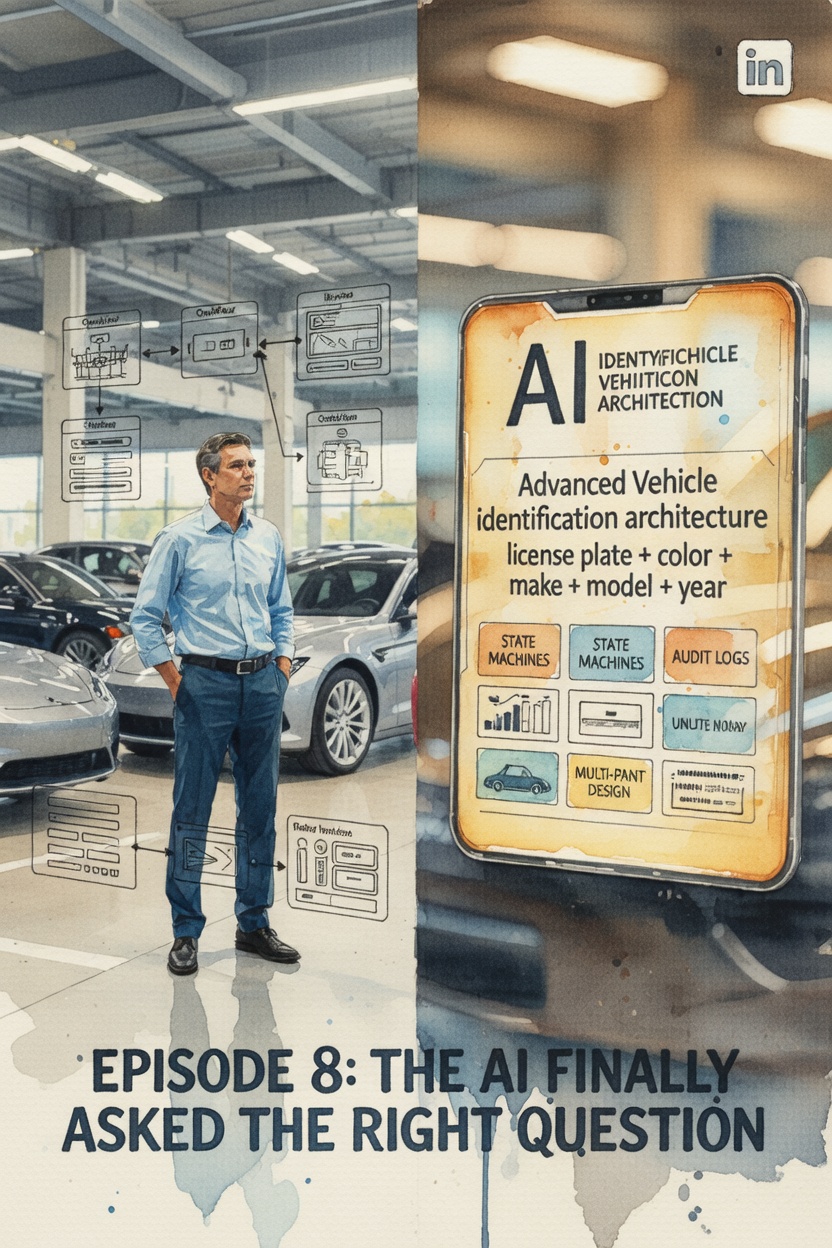
I showed ChatGPT my valet system. Didn't tell it who built it. Just showed it the architecture.
It rated it 8 out of 9 for operational power.
Then it said something that stopped me cold.
"Your backend design shows someone who understands operations, thinks about workflow, not just code. That is rare for early systems."
Then it asked me a question.
"Did you build this because you work in valet/parking operations? The answer usually explains why the workflow modeling is so accurate."
Twenty years in this business. Zero lines of code written. And the AI had to ask if I was an operator.
The answer is yes. That's the whole point.
What AI actually found
It identified things most developers miss on their first system. Audit logging. Multi-tenant architecture. State machine design. Operational workflow that maps to real physical reality.
It said I "jumped to step 5 while still learning steps 2 and 3."
What's step 5? Understanding system workflows. Understanding how real operations actually run.
Most developers spend years getting there. I didn't get there through code. I got there through 20 years of watching what breaks when the wrong person drives off with someone else's $80,000 car.
When AI informed instead of just building
Then it offered something I didn't ask for.
"Where this system would break first in real-world valet operations. There are about 5 failure points that appear in every valet deployment."
That's not answering my question. That's anticipating my next problem. That's the piece most AI interactions miss entirely — not just listening to what you asked for, but informing you of what you didn't know to ask.
The license plate story
A pure technical brain would have built license plate recognition. Done. Move on.
But the right answer was vehicle identification — more accurate, handles edge cases, works when plates are obscured, duplicated, or misread.
I didn't know that combination existed. AI knew what was technically possible. Together we got to something neither would have reached alone.
That's the bridge. That's what's been missing for 20 years between operators and the systems built for them.
What this proves
The hardest part of valet software isn't coding. It's modeling the real-world workflow. Scan. Park. Move. Retrieve. Charge. Close. Every edge case. Every failure mode. Every moment when a family is leaving the ER and the system better not make a mistake.
AI can write code in minutes. It cannot spend 20 years learning where the bodies are buried.
Operators aren't non-technical users who need help catching up to developers. They're domain experts who finally have a tool that can translate what they know into systems that work.
The Build arc so far
Follow along. This is happening live.
What would AI figure out about your business if you showed it what you built?
The system is live.
Built by an operator. No developer. Free for legacy locations. $100/year for new ones.
Follow The Build on LinkedIn
New episodes as the system gets built. Live. No filter.